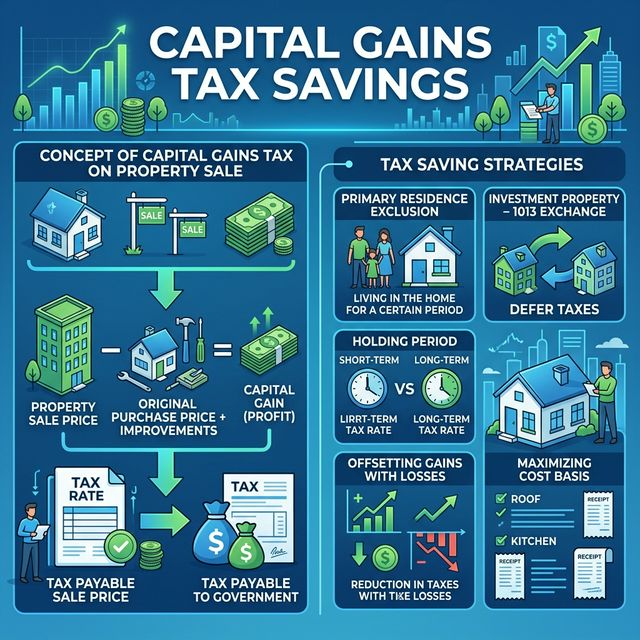
Capital Gains on Property Sale – How to Save Tax
Selling a property can give you significant profits - but it also brings a major tax liability if not planned properly. The good news is that with the right strategy, you can legally save a substantial amount of tax on capital gains.
Let’s break this down in a simple and practical way.
What is Capital Gains on Property?
When you sell a property at a higher price than what you purchased it for, the profit is called capital gain.
There are two types:
- Short-Term Capital Gain (STCG): If the property is sold within 2 years.
- Long-Term Capital Gain (LTCG): If held for more than 2 years.
Why Planning is Critical
Many people sell property first and think about tax later - this is where mistakes happen.
If you plan correctly before selling, you can save lakhs - sometimes even crores - in taxes.
The Income Tax Act provides multiple exemptions, but they come with strict conditions and timelines.
Section 54 – Best Option for Homeowners
If you are selling a residential property, Section 54 is the most powerful exemption.
How it works:
You must reinvest the capital gain in another residential property.You can buy:
- 1 year before sale, or
- 2 years after sale
- Or construct within 3 years
Key benefit:
Full exemption on capital gains if the entire gain is reinvested.Important point: You can now invest in 2 residential properties (once in a lifetime), subject to conditions.
Section 54F – For Non-Residential Assets
If you sold a plot, commercial property, or any asset other than a house, Section 54F applies.
Condition:
You must invest the entire sale value (not just the gain) into a residential property.Restrictions:
You should not own more than one residential property at the time of investment (excluding the new one).This section is slightly stricter, but still very effective if planned properly.
Capital Gains Account Scheme (CGAS)
What if you are unable to reinvest immediately?
You can park your capital gains in a Capital Gains Account Scheme (CGAS) before filing your income tax return.
This allows you to:
- Claim exemption now.
- Use the funds later within the allowed timelines.
Indexation – Hidden Advantage
For long-term capital gains, indexation helps reduce your taxable profit.
It adjusts your purchase price based on inflation, thereby lowering your capital gain. This is often ignored, but it can significantly reduce your tax liability.
Common Mistakes to Avoid
Even a small mistake can lead to a large tax outflow. Avoid these frequent pitfalls:
- Not planning before selling.
- Missing reinvestment timelines.
- Investing in the wrong type of asset.
- Not depositing in CGAS when required.
- Ignoring documentation and compliance.
Smart Strategy for Maximum Savings
To save maximum tax, follow this sequence:
1. Plan before selling 2. Estimate capital gains in advance 3. Choose the right exemption - Section 54 or 54F 4. Align timelines carefully 5. Use CGAS if needed 6. Select the right property with growth potential
Final Thought
Capital gains tax is not something to fear - it’s something to manage smartly.
With proper planning, you can not only save tax but also reinvest in a better asset that grows your wealth further.
At Camangal, we specialize in capital gains planning, tax advisory, and strategic real estate investments, ensuring that your money works efficiently for you - both legally and profitably.
If you are planning to sell a property, the right time to act is before the transaction - not after!
---*Disclaimer: This article is for informational purposes only and should not be considered as investment, tax, or legal advice. Real estate and tax laws are subject to change. For personalized advice, please consult CA Atul Mangal & Co.*